Showing posts with label Cambodia. Show all posts

Saturday, November 21, 2009

TRAVEL | Battambang

Battambang, the second largest city in Cambodia, is a relaxed and laid-back town, primarily a farmer and trader town around 3 hours from Siem Reap. It is the capital of the Battambang province in Cambodia, which is also known as the Rice Bowl of Cambodia becuase of its great production of rice.

Battambang is best known for its Angkor-period ruins at Ek Phnom and Phnom Banan, but there's also Phnom Sampeau - the site of the local Killing Fields, and of course the norry - an innovative Khmer "vehicle" used for travelling along the creaking railways.

Although not on the main tourist route, but it will be worth a visit if you want a place to experience the real Cambodia.

Rice cropping plays an important role in the provincial economy

Wat Ek
An Angkor-type temple ruin, about 15 km north west of Battambang. The road goes alongside lovely small rivers bordered by trees and small villages and is in general a very nice area.


Norry, the bamboo train
A good way to take in the countryside around Battambang is a ride on the bamboo train (called 'norry'). It is a unique and creative form of local transportation, consisting of a small motorcycle engine-powered bamboo cart that rides the railroad rails picking up and dropping off passengers, cargo, animals and motorcycles along the way.


Neak Ta DamBang Kragnoung
The symbol of the province. Battambang literally means loss of stick referring to a legend of Preah Bat Dambang Kranhoung when the King threw his wooden staff from Angkor and landed in present day Battambang

Wednesday, November 4, 2009

TRAVEL | Markets in Phnom Penh

Central Market
A 1930s Art Deco covered market near the Riverfront (Sisowath Quay) district. The market is well set out, and sells everything from flowers to video games. A typical market place for locals


Sorya Mall
Phnom Penh's main Western-style mall has air conditioning and contains a range of cheap fast food outlets. You can find inside the Lucky Supermarket, the only super market chain in Cambodia I believe


Russian Markets
A plase to buy real designer clothes at a huge discount price. A lot of major brand clothes sold here are deemed unfit to be shipped abroad due to very small fault in the clothing, therefore they are sold here at the Russian market.


There is also a huge western mall which opened recently called the city mall, near the olympic stadium. Can't wait to check all these out!

Wednesday, October 28, 2009

TRAVEL | Cambodia, Kingdom of Wonder

The phrase ‘‘Kingdom of Wonder’’ gives the impression of exploration and discovery, perfect for tourists seeking new experiences. ‘‘Wonder’’ is a reference to Angkor being nominated as one of the New Seven Wonders of the World. You can watch one version of the TV commercial here.


Monday, October 5, 2009

TRAVEL | Phnom Bakheng

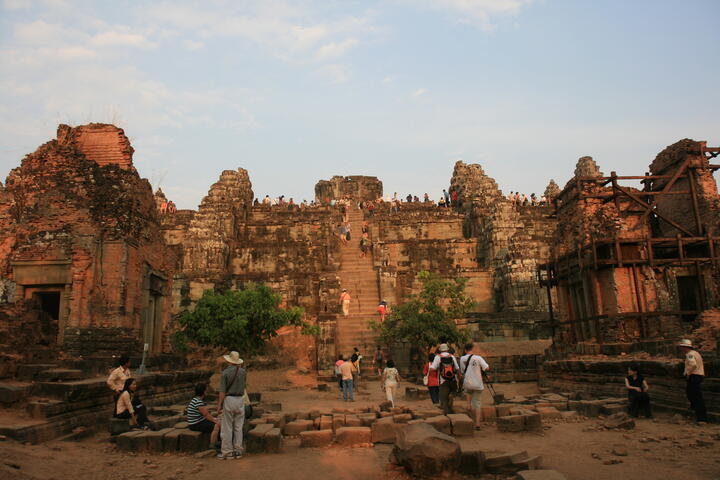
Another Hindu temple at the site of Angkor, Phnom Bakheng was one of the first temple mountains to be built in Angkor, two centuries before its neighbour the Angkor Wat. Situated atop a hill, it is nowadays a popular tourist spot for sunset views of the Angkor region, offering a view of the Tonle Sap Lake and a distant Angkor Wat in the jungle.

The temple is usually overcrowded at sunset, sometimes even completely overrun by tourists, making Phnom Bakheng one of the most threatened monuments of Angkor


Angkor Wat from Phnom Bakheng hill at sunset.

Thursday, September 24, 2009

LIFE | Cambodia: Royal Palace

A rare break in the clouds illuminates the Royal Palace in Phnom Penh last week before heavy rains returned to pummel the capital again on Tuesday.

The Phnom Penh Post, 23 September 2009. Photo by Heng Chivoan

Monday, September 21, 2009

LIFE | Cambodia: Pchum Ben

A woman offers food to monks at Wat Lanka as part of the traditional 15-day festival of Pchum Ben. Photo by Sovan Philong.
BACKGROUND: A history of Pchum Ben
What does Pchum Ben Festival mean in Buddhism? In the Khmer language, Pchum or Brochum means “a meeting or gathering”. Ben means “a ball of something”, such as rice or meat. The Pchum Ben festival originated in the Angkorian era when people followed animism, before Brahma or Buddhism.

Both Buddhism and animism reflect Khmer respect and remembrance for their ancestors.
Pchum Ben is also a convenient way for Buddhist monks to receive food during the heaviest part of the rainy season while they stay in the pagodas to follow their moral principles.

Celebrations
The first 14 days of the Khmer month Pheakta Bot are called Kan Ben (“observed celebration”). The 15th day is called Brochum Ben or Pchum Ben Day. During Kan Ben, people give Buddhist monks gifts of food and candles. At night Buddhist monks recite a protective prayer. Cambodian artists play traditional music such as yike and lakhon basac. Pchum Ben Day is the biggest celebration. Villagers come from all around to prepare the pagoda of their village the night before the celebration. Pchum Ben is when the villagers gather to celebrate in their villages.

Scriptures
The scriptures relating to the festival are complex, but the first scripture involves the five Buddhas negotiating with hungry ghosts. In the second scripture, from Pet Vuto (Monks’ Governor), the King’s servants and soldiers were commanded to make war. On the ship at night, they met ghosts who were hungry. The servants and soldiers asked: “How can we get food to you?” The ghosts said: “You can offer the food to the person among you who has the five moral conducts or eight moral conducts, and invoke our names.” The third and fourth scriptures say that in the first 15 days of Pheakta Both, the heaviest rainy period, the devil releases the ghosts to find their relatives to receive food.

Ghosts
There are four kinds of ghosts: those eating pus and blood, burning ghosts who are always hot, hungery ghosts and the Pakrakteaktopak Chivi, who can receive food through the monks. The others cannot receive food from their relatives until their sins are reduced to the level of Pakrakteaktopak Chivi.

What is bay ben?
Bay ben (balls of rice) are offered to ghosts at dawn. People believe ghosts with heavy sins cannot receive food during the day. Bay ben is made from sticky rice and sesame. Sometimes people add coconut cream to make it more delicious. Buddhist Institute consultant Miech Ponn said he thinks bay ben should be put on a plate. “Getting rice to the poor, people also can get more merit than only giving it to ants,” Miech Ponn said.

Source: The Phnom Penh Post, Friday 18 September 2009. Article by Ou Mom.

LIFE | Cambodia: Pchum Ben holiday and Teukai geckos

The streets around Wat Phnom teem with traffic as Cambodians begin their annual exodus from the capital to their hometowns ahead of this weekend's Pchum Ben holiday, when they will spend time with family and make offerings to their ancestors. An estimated 800,000 vehicles from the capital are expected to clog the Kingdom's roads.

The Phnom Penh Post, Friday 18 September 2009. Photo by Heng Chivoan.

Two teukai geckos hiss in the grass in Takeo province on Saturday. According to Khmer belief, these geckos will jump on anyone who touches them, attaching themselves around the neck, and can only be removed by seven virgins. The tone and number of bizarre cries they make in the night are also believed to hold the power to predict exam results and quality of a future marriage partner.

The Phnom Penh Post, Wednesday 09 September 2009. Photo by Tracey Shelton.

Thursday, September 17, 2009

LIFE | Flood in Phnom Penh

Beb, 3, defies the floodwater encroaching on his Chhbar Ampov commune home in Phnom Penh on Tuesday. The severe storms that have been lashing Cambodia for the past few weeks have so far killed nine people, destroyed 28,949 hectares of rice and damaged 13,638 homes, according to the National Disaster Committee.

The Phnom Penh Post, Wednesday 16 September 2009. Photo by Sovan Philong

Wednesday, September 16, 2009

LIFE | Fighting Fish in Cambodia

Municipal police broke up a fish-fighting and -betting ring in Chamkarmon district on Saturday, arresting 23 people and confiscating 72 fish. In a typical fight, two Siamese fighting fish - native to the rice paddies of Cambodia - are placed in one jar, prompting a mutual attack. The victor is declared when one retreats to the jar's perimeter, the other in hot pursuit. The activity becomes illegal when the owners of the fish bet on the outcome. Municipal Police Chief Touch Naruth said the 23 men were briefly re-educated and then released. "It is not as serious as card-playing, but it is still gambling," he said.

The Phnom Penh Post, Monday 07 September 2009. Photo by Heng Chivoan.

Friday, September 4, 2009

BUSINESS | The Airbus has landed in Cambodia

Ground staff at Phnom Penh International Airport walk past a new Airbus A321 delivered Wednesday to the Kingdom's new national carrier Cambodia Angkor Air. The airline - a joint venture between the Cambodian government and Vietnam Airlines - plans to use the aircraft to expand its services. The Airbus will begin flights on Saturday, an official said Tuesday. Photo by Heng Chivoan. Source: The Phnom Penh Post, Thursday 3 September 2009.

Sunday, August 30, 2009

LIFE | Phnom Penh

Street seller Phar Sideth runs to meet a potential customer in front of the Royal Palace on Tuesday. The 14-year-old said he works every day selling three small bags of corn and beans for 500 riels (US$0.12) for feeding pigeons in the park. Photo by Sovan Philong. Source: The Phnom Penh Post Thursday 27 August 2009.

Thursday, August 27, 2009

TRAVEL | Preah Khan

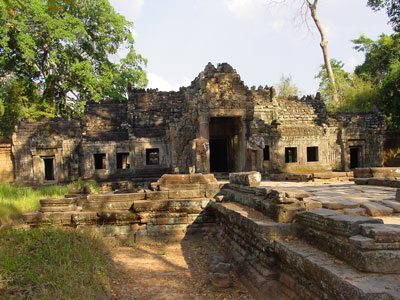
This will be the last of the temples I will be introducing in the Angkor archeological park. Preah Khan (Sacred sword) is a Khmer temple built by the king Jayavarman VII in honour of his father, and is architecturally in harmony with Ta Prohm. Like Ta Prohm, the temple itself has been left largely unrestored, allowing nature to mix with man made structures. The temple was originally used as a Buddhist monastery and school, engaging over 1000 monks.

Today, the Buddha carvings/images in the temple have been vandalised or destroyed in the anti-Buddhist reaction under the proceeding King Jayavarman VIII.


Tuesday, August 25, 2009

TRAVEL | Ta Prohm

Ta Prohm (Ancestor Brahma) is a Khmer temple approximately 1km east of the old Angkorian capitol Angkor Thom. Founded by the King Javaraman VII in the late 12th century, the temple was built as a Mahayana Buddhist monastery and university dedicated to the mother of King. The beauty of this temple lies in the fact that it has been left in the same condition as it was found, showing the dynamic interaction between nature and man made art.

Because of its natural state, visitors are able to experience the wonders of discovering a real ruin like early explorers did in the nineteenth century. The photogenic and atmospheric combination of trees growing out of the ruins and the jungle surroundings have made it one of Angkor's most popular temples with visitors.

This was the site where the first Tomb Raider movie was filmed.


Monday, August 24, 2009

TRAVEL | Angkor Wat


Situated in Angkor, the Angkor Wat is a grand temple complex built for the king Suryavarman II as his state temple, in the early years of 12th century. The Angkor Wat is unusual in Khmer temples in that it faces the west, instead of the east, leading many to speculate that Suryavarman intended it to serve as his funerary temple. Based on the decorations and structures found there, scholars believe that the temple is dedicated to the worship of Lord Vishnu, a supreme god in Hindu religion.


Angkor Wat, which means city temple in Khmer, demonstrates the epitome of high classical style of Khmer architecture. The temple itself was designed to represent Mount Meru, home of the devas in Hindu mythology. The quincux of towers in Angkor Wat represent the five peaks of Mount Meru, while the surrounding walls and moat represent the surrounding mountain ranges and seas. This style of temple design was the dominant scheme for the construction of state temples in the Angkorian period, and was known as temple mountain.


View Larger Map

Thursday, August 20, 2009

TRAVEL | Angkor - The Bayon Temple

From today, I'll be introducing a series of sites located in the Angkor Archaeological Park, one of the most important archaeological site in South-East Asia. It contains the magnificent remains of the different capitals of the Khmer Empire from the 9th - 15th century. The ruins of Angkor are a UNESCO World Heritage Site.

The structures one sees at Angkor today, more than 100 stone temples in all, are the surviving remains of a grand religious, social and administrative metropolis whose other buildings - palaces, public buildings, and houses - were built of wood and are long since decayed and gone.

The Bayon temple is a Khmer Temple situated at the absolute centre of the ancient city Angkor Thom. Built in the late 12th century by King Jayavarman VII, the Bayon temple is one of the most distinct temples in Siam Reap because of the many serene and massive stone faces that are decorated on the towers of the temple. There are a total of 54 towers each with 4 stone faces, making a total of 216 faces. The person depicted on the towers remain a mystery. Some say it's the King himself, some say it's the Buddha.

The Bayon was the last state temple to be built at Angkor, and the only Angkorian state temple to be built primarily as a Mahayana Buddhist shrine dedicated to the Buddha.


View Larger Map

Tuesday, August 18, 2009

TRAVEL | Temple of Preah Vihear

The Preah Vihear temple (meaning sacred temple in Khmer) is situated on the edge of a plateau, on a 525-metre cliff that dominates the plain of Cambodia. Dated back to the 11th century AD, the temple is composed of a series of sanctuaries linked by pavements and staircases over a 800 metre long axis, showcasing outstanding Khmer architecture. The site is very well preserved, being in a remote location, on the Dangrek Mountains, border between Cambodia and its neighbor Thailand. It is unusual among Khmer temples in being constructed along a long north-south axis, rather than having the conventional rectangular plan with orientation toward the east.

In July 2008, the Preah Vihear was listed as a UNESCO World Heritage Site.


View Larger Map